
How to Value a Digital Asset Before Buying or Selling Online
Learn practical methods to accurately value digital assets like code scripts, design templates, and online stores before entering a marketplace deal.
Understanding the Importance of Accurate Digital Asset Valuation
Entering the digital marketplace as either a buyer or seller requires a clear understanding of asset valuation. Unlike physical goods with tangible material costs, digital products—such as source code, web templates, graphics packages, and turnkey websites—derive their worth from utility, market demand, scalability, and historical performance. Setting an inaccurate price can result in unsold inventory for sellers or overpayment for buyers.
Developing an objective framework for valuation helps ensure fair transactions. By focusing on verifiable metrics, maintenance requirements, and market trends, both parties can negotiate with confidence and achieve mutually beneficial outcomes.
Key Factors in Valuing Digital Products and Assets
Determining the fair market value of a digital asset involves analyzing several core elements. Whether you are listing a asset for sale or evaluating a potential purchase, consider the following critical factors:
- Revenue and Profit History: For assets that generate ongoing income, historical earnings are the primary valuation metric. Buyers typically evaluate net profit rather than gross revenue to account for hosting, payment processing, and marketing costs.
- Development Effort and Technical Quality: The complexity of the underlying code, quality of documentation, and adherence to modern security standards influence baseline value. Clean, well-documented code reduces onboarding time for buyers.
- Market Demand and Niche Relevance: Assets addressing high-demand niches or solving urgent business problems command higher prices. Conversely, products in saturated markets require distinct competitive advantages to maintain value.
- Intellectual Property and Originality: Fully original code, custom graphics, and proprietary workflows carry higher valuation than products relying heavily on third-party frameworks or open-source dependencies.
- Maintenance and Operational Overhead: A digital product requiring minimal ongoing updates is generally more valuable than one demanding constant maintenance, bug fixes, or customer support.
Common Valuation Methods for Digital Products
1. Income Multiplier Method
The income multiplier approach is standard for earning assets, such as established SaaS tools, content websites, or active e-commerce platforms. Valuation is calculated by applying a multiple to the asset's average monthly or annual net profit.
For example, an asset generating steady net profit may be valued at a multiple reflecting its stability, growth trajectory, and risk profile. Lower-risk assets with predictable passive income receive higher multiples, while assets dependent on heavy manual operations receive lower multiples.
2. Cost-to-Replicate Method
When valuing newer assets without sales history—such as newly coded scripts, UI kits, or site templates—the cost-to-replicate approach is often used. This method calculates what it would cost in time, design, and engineering resources to rebuild the asset from scratch.
- Estimate the total development hours required by a skilled professional.
- Apply standard hourly industry rates for design and engineering.
- Incorporate costs for specialized software, licenses, or testing environments used during creation.
This baseline figure provides a realistic minimum value for the creator's labor and intellectual investment.
3. Comparable Market Analysis
Similar to real estate, digital assets can be valued by comparing recent sales of similar products across established marketplaces. When analyzing comparable listings, evaluate pricing for assets with similar feature sets, code quality, customer support inclusions, and licensing terms.
Valuation Checklist for Buyers
Before purchasing a digital asset, buyers should perform thorough due diligence to verify that the asking price aligns with actual value:
- Review Source Code and Documentation: Request a preview or audit code architecture to ensure it is clean, scalable, and easy to maintain.
- Verify Traffic and Revenue Claims: Ask for verified analytics reports and financial statements covering at least 6 to 12 months.
- Assess Transferability: Ensure all relevant components, including source files, licenses, domains, and design assets, can be seamlessly transferred upon purchase.
- Evaluate Support Terms: Determine whether the purchase includes post-sale technical support or updates, which adds significant practical value.
Valuation Checklist for Sellers
Sellers looking to maximize listing value and attract serious buyers should prepare their assets before setting a price:
- Organize Documentation: Prepare comprehensive installation guides, API documentation, and user manuals. Well-documented products justify higher price points.
- Clean Up Code and Assets: Remove obsolete files, resolve known bugs, and format project files cleanly.
- Package Deliverables Efficiently: Ensure all necessary files are bundled securely for immediate delivery upon transaction completion.
- Provide Transparent Earnings Proof: If selling an income-generating asset, compile clear financial summaries detailing income and operational expenses.
Conclusion
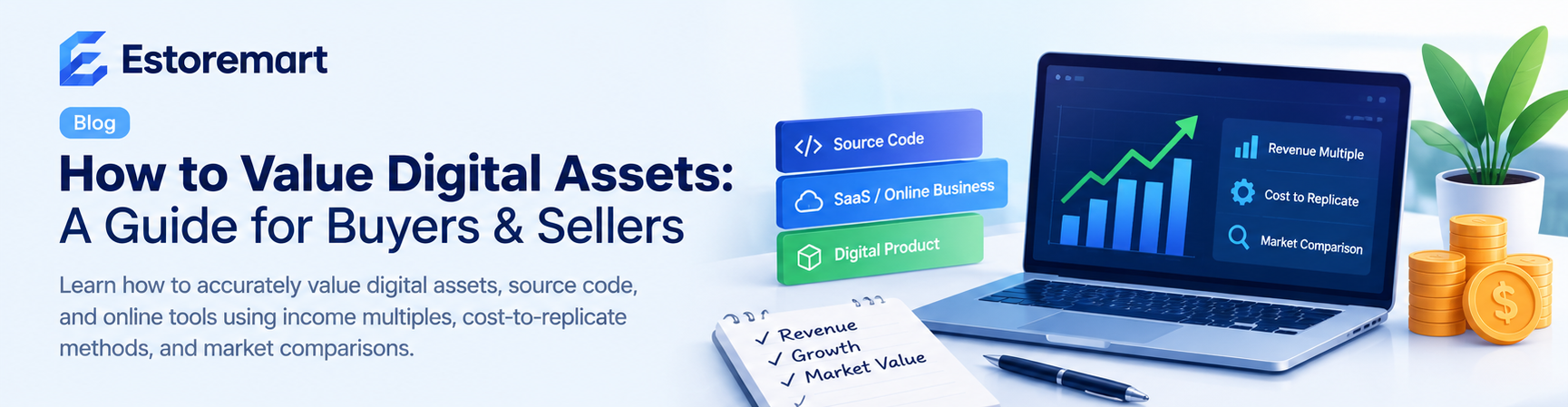
Accurate digital asset valuation protects both buyers and sellers, fostering transparent and reliable commercial exchanges. By applying structured valuation methods like income multiples, cost-to-replicate assessments, and market comparisons, market participants can execute transactions rooted in real economic value.
Whether you are looking to acquire verified digital assets or ready to list your custom development work, explore the options available on Estoremart to connect with buyers and sellers today.
Related articles
Continue exploring more articles from the Estoremart blog.

How to Audit a Digital Asset Blueprint Before Making a Purchase
Learn how to evaluate digital assets, source code, design systems, and automation scripts before purchasing. This practical audit framework helps buyers verify quality, security, and maintainability.
A Guide to Evaluating Code Market Scripts for Custom Web Applications
Learn how to evaluate pre-built scripts, boilerplate code, and software components for custom web development projects while balancing technical debt, licensing, and maintainability.
Choosing the Right SaaS Boilerplate for Your Next Web Application
A practical framework for evaluating production-ready starter kits, tech stacks, and architecture blueprints to accelerate software launch timelines.